Honda
Passport


This estimate illustrates a vehicle lease. It is informational, not a financing offer or approval. Actual payments depend on negotiated price, residual value, money factor, mileage allowance, taxes, fees, credit, and lender terms.
This estimate illustrates vehicle financing. It is informational, not a credit offer or approval. Actual payments depend on purchase price, down payment, annual percentage rate, term, taxes, fees, credit, and lender terms.
This estimate illustrates a vehicle lease. It is informational, not a financing offer or approval. Actual payments depend on negotiated price, residual value, money factor, mileage allowance, taxes, fees, credit, and lender terms.
Honda Passport service offers offers
Honda Passport service offers offers
More
About this car
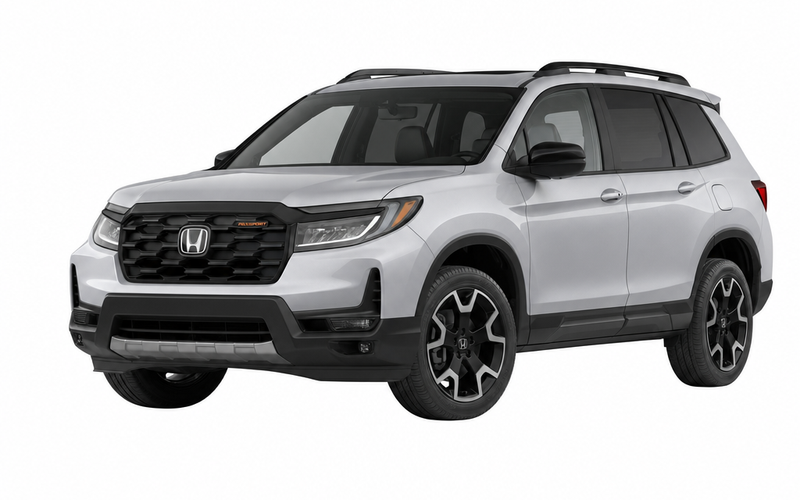
Honda Passport Positioning: A Two-Row Midsize SUV That Puts Trail Capability First
The Honda Passport occupies a narrow slot in the American midsize SUV market: a two-row, five-seat crossover with standard all-wheel drive and genuine off-road hardware. Rather than chasing third-row capacity like the Honda Pilot or rival seven-seat crossovers, the Passport leans into its role as a gear-hauling, trail-worthy alternative. Its direct competitors are the Jeep Grand Cherokee and Toyota 4Runner, both two-row bodies with real four-wheel-drive pedigree. The reason to consider the Passport over those names is its balance, pairing a V6 with a 10-speed automatic and the second-generation i-VTM4 AWD system to deliver capability without abandoning on-road composure. It starts at $45,195 MSRP, near the Grand Cherokee and below most 4Runner TrailHunter pricing. Source: https://automobiles.honda.com/passport
Why Consider the Honda Passport
The Passport's main draw is that it does not force a compromise between daily driving and weekend trail work. Standard AWD, seven drive modes (Normal, ECON, Sport, Snow, Trail, Sand, and Tow), and a 5,000-pound towing capacity make it usable for boat owners and overlanders alike.
Compared directly with the Jeep Grand Cherokee, the Passport offers simpler packaging—every trim comes with the V6 and AWD, so there is no base four-cylinder or rear-drive variant to dilute the value. The Grand Cherokee's base model starts lower but climbs once you option the V6 and 4x4 hardware.
- Standard second-generation i-VTM4 AWD on every trim, with torque-vectoring to the rear wheels.
- 280-horsepower V6 paired exclusively with a 10-speed automatic transmission.
- Towing capacity of up to 5,000 pounds with trailer stability support.
- TrailSport trims add a 1-inch lift, all-terrain tires, steel skid plates, and 9.6 inches of ground clearance.
Specifications and Powertrains
Gasoline V6 — The only engine offered in the US market is a 3.5-liter V6 rated at 280 horsepower, mated to a 10-speed automatic transmission. All-wheel drive is standard across the lineup, with the second-generation i-VTM4 system capable of distributing torque to individual rear wheels. EPA fuel economy is 19 mpg city / 25 mpg highway, and the fuel tank holds 18.5 gallons. The engine carries a LEV4 ULEV70 emissions rating.
Electrified powertrains — Not offered in this generation. The Passport skips hybrid and plug-in options entirely, so shoppers wanting electrification in a two-row body must look to the Toyota 4Runner hybrid or the Hyundai Santa Fe Hybrid instead.
Payment Reality: What Drives the Monthly Cost
The Passport's starting MSRP of $45,195 puts it in a pricing band where financing terms matter as much as the sticker. Because every trim includes the V6 and AWD, there is no low-entry base version to soften the monthly figure; the cheapest RTL already carries the full drivetrain. Depreciation is the second lever. The Passport holds value better than many mainstream crossovers but trails the Toyota 4Runner's legendary resale, which keeps lease residuals higher and used prices firmer. Down payment, interest rate, and term length are the variables the payment calculator will resolve. Source: https://automobiles.honda.com/passport
Warranty and Maintenance
Honda covers the Passport with a 3-year/36,000-mile bumper-to-bumper warranty and a 5-year/60,000-mile powertrain warranty. Scheduled service follows Honda's standard oil-change interval of every 7,500 miles or 12 months, with no special break-in maintenance required. Dealership networks are dense across the United States, so parts availability is generally strong, but independent shops can handle most Passport work affordably because the 3.5-liter V6 is shared with the Pilot and Odyssey. The 10-speed automatic needs fluid attention at longer intervals, and the AWD rear clutch packs merit inspection after heavy off-road use. Always verify whether aftermarket suspension or tire changes void factory coverage.
Who the Honda Passport Suits
The Passport fits households that need five seats and real cargo space for outdoor gear but do not need a third row. Frequent tow users with boats or small trailers up to 5,000 pounds, weekend trail drivers who want factory-backed clearance rather than aftermarket lifts, and drivers in snow states who value standard AWD all fit the profile. If third-row seating or better fuel economy matters more, the Honda Pilot, Hyundai Santa Fe, and Kia Sorento are worth a look; if maximum off-road credibility outweighs on-road manners, the Jeep Wrangler and Toyota 4Runner remain the benchmarks.