Chevrolet
Trailblazer


This estimate illustrates a vehicle lease. It is informational, not a financing offer or approval. Actual payments depend on negotiated price, residual value, money factor, mileage allowance, taxes, fees, credit, and lender terms.
This estimate illustrates vehicle financing. It is informational, not a credit offer or approval. Actual payments depend on purchase price, down payment, annual percentage rate, term, taxes, fees, credit, and lender terms.
This estimate illustrates a vehicle lease. It is informational, not a financing offer or approval. Actual payments depend on negotiated price, residual value, money factor, mileage allowance, taxes, fees, credit, and lender terms.
Chevrolet Trailblazer maintenance offers offers
Chevrolet Trailblazer maintenance offers offers
More
About this car
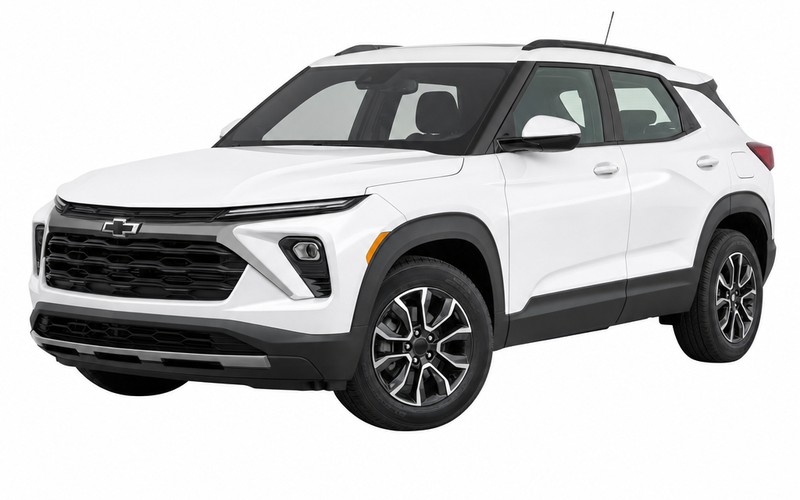
Chevrolet Trailblazer: A Sub-$24,000 Small SUV That Prioritizes Cargo Flexibility
The Chevrolet Trailblazer occupies the value end of the subcompact crossover segment, where it squares off against the Hyundai Kona, Kia Soul, and the rougher-edged Ford Bronco Sport. It starts at $23,600 and reaches about $28,595 on the RS trim, making it one of the more affordable five-passenger SUVs sold in the United States (https://www.chevrolet.com/suvs/trailblazer). The Trailblazer's main draw is packaging: a fold-flat front passenger seat that carries objects up to 8.5 feet long, a two-tier cargo floor, and a standard driver-assistance suite. It is a pragmatic pick for buyers who want SUV practicality without paying compact-crossover prices.
The lineup splits into four trims — LS, LT, ACTIV, and RS — with front- or all-wheel drive. LT adds convenience features, ACTIV gets off-road suspension tuning, and RS wears a sportier appearance with larger wheels and unique interior trim.
Why consider the Chevrolet Trailblazer
The Trailblazer's strongest argument is usable interior for the price. The fold-flat front passenger seat and reversible cargo floor stand out in a segment where rivals like the Kia Soul offer boxy space but no equivalent cargo-length flexibility. Standard Chevy Safety Assist — six features including automatic emergency braking and lane keep assist — arrives on every trim at no extra cost, which is uncommon in this price band.
With AWD available across the line, the Trailblazer handles loose surfaces competently, though the ACTIV trim's unique shocks and sport-terrain tires are the ones to choose if real trail use matters (https://www.chevrolet.com/suvs/trailblazer).
- Fold-flat front passenger seat creates 8.5 feet of cargo length for longer items
- Standard Chevy Safety Assist with six driver-assistance features
- All-wheel drive available on every trim level
- 39.4 inches of rear-seat legroom, above average for the class
- Three selectable drive modes on turbo-equipped models
Specifications and powertrains
1.2L turbocharged three-cylinder. Front-drive LS and LT models use the ECOTEC 1.2L turbo paired with a continuously variable transmission, a combination tuned more for efficiency than acceleration.
1.3L turbocharged three-cylinder. All-wheel-drive versions and the ACTIV and RS trims use the ECOTEC 1.3L turbo, rated at a maximum of 174 lb-ft of torque and mated to a nine-speed automatic with three drive modes (https://www.chevrolet.com/suvs/trailblazer). EPA fuel-economy figures vary by drivetrain; buyers choosing 1.2L front-drive versions typically get the best highway numbers, while 1.3L AWD models trade some efficiency for traction.
Electrification. There is no hybrid or EV variant in the current U.S. lineup. All Trailblazer gasoline models keep the entry price low but limit choice against hybrid competitors in the segment.
Payment reality
Financing a Trailblazer depends mostly on trim and drivetrain rather than engine choice — the $23,600 base LS and the $28,595 RS represent a spread of roughly $5,000 before options (https://www.chevrolet.com/suvs/trailblazer). Subcompact crossovers also depreciate faster than compact SUVs, so a shorter loan term or a larger down payment helps mitigate negative equity risk. Lease residuals on the Trailblazer are competitive with other Chevrolet small SUVs but less favorable than on more popular models like the Toyota Corolla Cross. Use the CarPayCheck payment calculator to model your own term and rate — the monthly figure depends on price, down payment, and finance rate, not a fixed sticker number.
Warranty and maintenance
Every Chevrolet comes with bumper-to-bumper coverage for 3 years or 36,000 miles and a powertrain warranty for 5 years or 60,000 miles, terms consistent with the segment norm (https://www.chevrolet.com/suvs/trailblazer). Scheduled service follows GM's plan, with oil changes and tire rotations typically recommended around every 7,500 miles; the 1.2L and 1.3L engines run conventional intervals rather than the extended ones found on some new Toyota or Honda units. Parts availability is strong nationwide, and the Trailblazer can be serviced at any Chevrolet dealer or an independent shop with access to GM parts — no proprietary tools required, which keeps routine costs reasonable.
Who the Chevrolet Trailblazer suits
The Trailblazer fits buyers who want a small-SUV footprint but occasional big-cargo capacity — kayaks, ladders, or bulky gear that the 8.5-foot load length accommodates with the front seat folded. It also suits those who want standard active safety features without paying for a higher trim. The ACTIV trim extends its reach to light off-roading, while AWD versions handle winter conditions. If you have no off-road intent, the Kia Soul costs less and offers similar cabin space; for hybrid efficiency, the Toyota Corolla Cross and Hyundai Kona Hybrid are worth comparing. If towing or serious trail duty matters, the Ford Bronco Sport is stronger, though pricier (https://www.chevrolet.com/suvs/previous-year/trailblazer).