
Cadillac
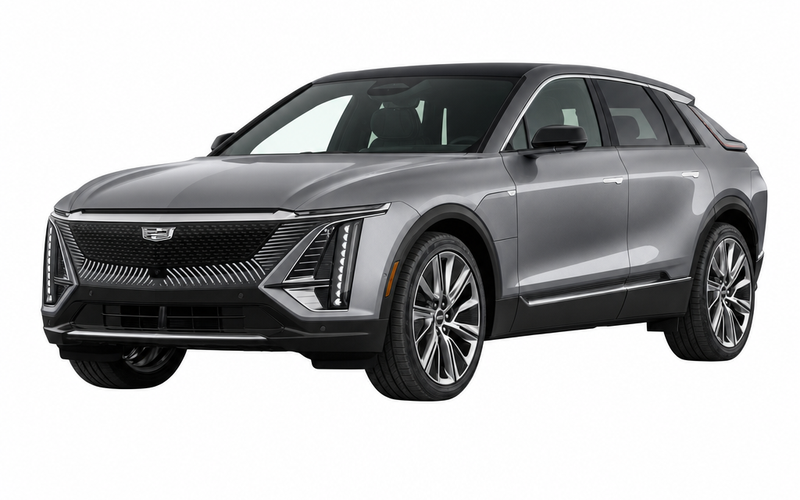
LYRIQ


This estimate illustrates a vehicle lease. It is informational, not a financing offer or approval. Actual payments depend on negotiated price, residual value, money factor, mileage allowance, taxes, fees, credit, and lender terms.
This estimate illustrates vehicle financing. It is informational, not a credit offer or approval. Actual payments depend on purchase price, down payment, annual percentage rate, term, taxes, fees, credit, and lender terms.
This estimate illustrates a vehicle lease. It is informational, not a financing offer or approval. Actual payments depend on negotiated price, residual value, money factor, mileage allowance, taxes, fees, credit, and lender terms.
Cadillac LYRIQ maintenance offers offers
Cadillac LYRIQ maintenance offers offers
More
About this car
Cadillac LYRIQ: A Full-Size Electric Luxury SUV Priced From $59,200
The LYRIQ is Cadillac's first dedicated electric SUV, entering a segment currently led by the Tesla Model X, Rivian R1S, and Mercedes-Benz EQS SUV. With a base price of $59,200 in the Luxury trim and an EPA-estimated 326 miles of range in the rear-wheel-drive configuration, it competes primarily on three fronts: cabin space, charging rate, and vehicle-to-home (V2H) capability — the latter being rare in this price band. The model skips the multiple fuel options of rivals, offering a single battery-electric powertrain with two drive configurations plus a high-performance V-Series variant.
The main reason to consider the LYRIQ is its charging mix: a standard 11.5 kW AC onboard module, an optional 19.2 kW upgrade, and public DC fast charging at up to 190 kW. That combination — plus a North American Charging System (NACS) port — positions it as a practical all-rounder for buyers who want a large luxury SUV that charges quickly both at home and on the road.
Why Consider the Cadillac LYRIQ
Against the Tesla Model X, the LYRIQ offers more conventional luxury appointments — a 33-inch Horizon Display, heated and ventilated front seats, and a SkyGlass roof with power shade — without Tesla's frequent price changes. Versus the Rivian R1S, it brings comparable range (326 vs. 300+ miles EPA) but adds V2H compatibility, letting the vehicle act as a home backup power source, a feature most competitors charge extra for or omit.
The strengths that stand out for comparison shoppers:
- EPA-estimated 326 miles of range (RWD) from a 102 kWh lithium-ion battery
- 190 kW DC fast charging adds up to 86 miles in about 10 minutes at public stations
- V2H compatibility and 19.2 kW AC charging for home use in the available trims
- Lyriq-V performance variant delivers 615 hp and 650 lb-ft in Velocity Max mode
- North American Charging System (NACS) port aligns with the Tesla Supercharger network
LYRIQ Powertrains: One Platform, Three Drive Configurations
Single motor, rear-wheel drive (RWD): The base setup uses Cadillac-estimated 365 hp and 325 lb-ft of torque, returning an EPA-estimated 326 miles of range. The motor sits at the rear for improved balance, and the 102 kWh battery (NCMA cathode, blended graphite anode) is common across trims.
Dual motor, all-wheel drive (AWD): Adds a second motor for 515 hp and 450 lb-ft, dropping EPA range to 319 miles. This configuration supports an optional 19.2 kW AC charging module, which adds up to 50.9 miles of range per hour at compatible home chargers.
Lyriq-V: The performance trim uses a dual-motor AWD system with Cadillac-estimated 615 hp and 650 lb-ft in Velocity Max, plus Brembo front brakes and a 5-link suspension. Charging stays at 11.5 kW AC standard and 190 kW DC — the same DC rate as other trims — with all versions wearing the NACS charge port.
Payment Reality: What Drives the LYRIQ's Monthly Numbers
LYRIQ prices span $59,200 (Luxury base) to $83,900 (Lyriq-V Premium), with destination fees typically adding a few hundred dollars. Monthly payments depend heavily on the residual-value outlook for a brand-new, low-volume EV model: early production units tend to depreciate faster than established competitors like the Tesla Model X, which has a stronger resale history. Lease programs from Cadillac can soften that hit by fixing the buyout, but a purchase requires factoring in battery-health resale discounts that apply to most EVs. Use the payment calculator above to see how trim, term, and down payment translate into a specific figure — the calculator owns that number.
Warranty and Maintenance on the LYRIQ
The LYRIQ carries Cadillac's standard EV warranty: 8-year/100,000-mile battery coverage and 5-year/60,000-mile bumper-to-bumper protection, with the first scheduled maintenance visit (tire rotation and multipoint inspection) at 7,500 miles. Service intervals follow a 12-month calendar — cabin air filter replacement, brake fluid checks, and cooling-system inspections — best handled at a Cadillac dealer for warranty compliance. Independent shops increasingly service EVs, but LYRIQ-specific parts (like the 33-inch display or SkyGlass roof mechanism) may still require dealer sourcing in the first years after launch.
Who the Cadillac LYRIQ Best Serves
The LYRIQ suits buyers who want a large, quiet electric SUV with genuine home-integration capability — particularly V2H users who need the vehicle as a backup power source. Road-trippers benefit from the 326-mile range and 190 kW fast charging, while tech-forward owners may appreciate the Google built-in assistant and 33-inch display. If you don't need the V2H feature or the interior tech, the Tesla Model X and Rivian R1S offer more proven software ecosystems; for those prioritizing a traditional luxury-cabin feel with EV efficiency, the Mercedes-Benz EQS SUV remains a worthy comparison. All three are solid alternatives depending on whether range, charging speed, or cabin refinement leads your decision.