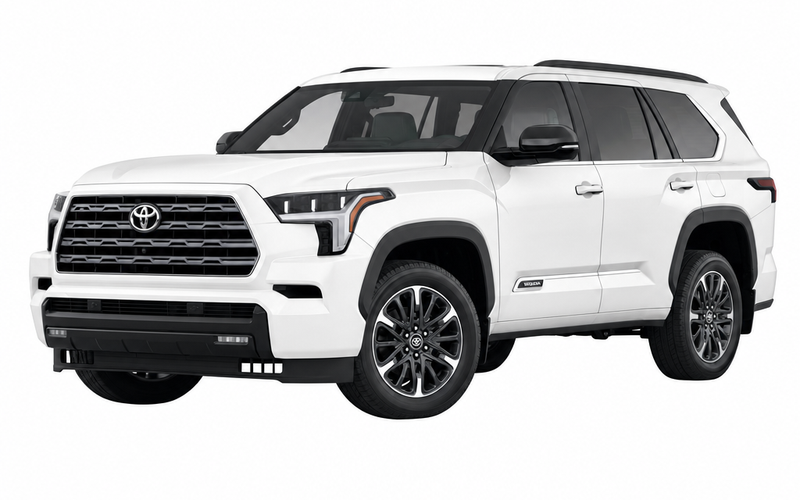
Toyota Sequoia Positioning: A Hybrid-Only Full-Size SUV With Truck DNA
The Toyota Sequoia occupies a narrow slice of the full-size SUV segment: a body-on-frame, three-row family hauler offered exclusively with a hybrid powertrain. In the United States market it lines up against the Chevrolet Tahoe, GMC Yukon and Ford Expedition, all of which still offer conventional V8 or turbocharged V6 options. Toyota's bet is that a twin-turbo V6 hybrid can deliver the towing and payload capability buyers expect from a truck-based SUV while returning noticeably better fuel economy than the V8 competition. That combination, plus a dedicated off-road TRD Pro grade, gives the Sequoia a distinct reason to exist in a segment where most rivals play it conventional.
Why Consider Toyota Sequoia
The Sequoia's main argument is efficiency without giving up capability. Its hybrid powertrain, which Toyota calls i-FORCE MAX, pairs a twin-turbo 3.4-liter V6 with an electric motor to produce 437 horsepower and 583 lb.-ft. of torque — figures that beat the base Chevrolet Tahoe's 5.3-liter V8 while returning up to an EPA-estimated 22 combined mpg, per Toyota's own materials at toyota.com/sequoia/. That is a meaningful gap versus the Tahoe's sub-20 combined ratings for its V8 models.
It also pulls hard: Toyota lists maximum towing up to 9,500 lbs when properly equipped, with an integrated trailer brake controller and available load-leveling rear air suspension. Unlike the Expedition, which offers a non-hybrid EcoBoost V6 as the base engine, the Sequoia has no non-hybrid option — every trim uses the same electrified powertrain, simplifying the decision tree.
- Standard hybrid powertrain across all trims with 437 hp and 583 lb.-ft. of torque
- Towing capability up to 9,500 lbs with available Tow/Haul and Tow+ modes
- TRD Pro grade with Multi-Terrain Select, Crawl Control and Downhill Assist Control for off-road use
- Second-row bench seats for eight passengers or captain's chairs for seven
- Standard Toyota Safety Sense driver-assistance suite
Specifications and Powertrains
i-FORCE MAX hybrid (only powertrain) — All Sequoia grades use a twin-turbo 3.4-liter V6 paired with a permanent-magnet synchronous electric motor integrated into a 10-speed automatic transmission. System output is 437 hp and 583 lb.-ft. of torque. Toyota quotes a maximum towing figure of up to 9,500 lbs for properly equipped models, and an EPA-estimated 22 combined mpg on 2WD configurations, with 4WD slightly lower. The hybrid battery and motor are covered under Toyota's hybrid-component warranty.
Fuel economy context — In a segment where the Ford Expedition EcoBoost returns roughly 18 combined mpg and the Chevrolet Tahoe's V8 models fall around 16-17 combined mpg, the Sequoia's 22 combined mpg figure is a genuine advantage for buyers covering high annual mileage. Actual mileage varies with load, towing and weather, as with any vehicle in this class.
Payment Reality
The Sequoia's base price lands in the low $60,000 range, and well-equipped Platinum, Capstone and 1794 Edition trims push well past $75,000 before destination charges. Monthly payments on a loan or lease depend on term, down payment, interest rate and residual value — and that last factor matters more here than on smaller SUVs. Full-size body-on-frame vehicles tend to hold value well when fuel prices stay moderate, but the Sequoia's premium pricing means depreciation risk is higher in absolute dollars. Use the CarPayCheck calculator with a realistic interest rate and term to see the actual monthly figure for your trim and mileage scenario.
Warranty and Maintenance
Toyota covers the Sequoia with a 3-year/36,000-mile basic warranty and a 5-year/60,000-mile powertrain warranty, with hybrid components covered for 8 years/100,000 miles (10 years/150,000 miles in emissions-focused states). ToyotaCare provides complimentary scheduled maintenance for 2 years or 25,000 miles, which covers oil changes and tire rotations. Beyond that, the recommended service schedule typically calls for inspections at 5,000-mile intervals and oil changes at 10,000 miles. Parts availability is strong nationwide through Toyota dealers; independent shops can handle routine work, but hybrid-system repairs are best left to dealers while the warranty is active.
Who Toyota Sequoia Suits
The Sequoia fits buyers who need full-size, truck-based capability and regularly tow boats, trailers or campers, but still want better fuel economy than a traditional V8 SUV offers. It also suits large families who actually use the third row and prefer a body-on-frame ride to a unibody crossover. If you rarely tow and want a smoother, more car-like ride, the Chevrolet Tahoe with independent rear suspension or the Ford Expedition with its flexible seating system may be better choices. For off-road use, the Jeep Wagoneer is a capable alternative, though it lacks the Sequoia TRD Pro's dedicated rock-crawling hardware.