C

Toyota
Prius
Purchase price from $28,550
from
$332
per month
per mo.


This estimate illustrates a vehicle lease. It is informational, not a financing offer or approval. Actual payments depend on negotiated price, residual value, money factor, mileage allowance, taxes, fees, credit, and lender terms.
This estimate illustrates vehicle financing. It is informational, not a credit offer or approval. Actual payments depend on purchase price, down payment, annual percentage rate, term, taxes, fees, credit, and lender terms.
This estimate illustrates a vehicle lease. It is informational, not a financing offer or approval. Actual payments depend on negotiated price, residual value, money factor, mileage allowance, taxes, fees, credit, and lender terms.
from
$332
per month
per mo.
New
New Toyota Prius offers
Used
Used Toyota Prius offers
Services
Toyota Prius service offers
Maintenance
Toyota Prius maintenance offers
New Toyota Prius offers
New Toyota Prius offers
There are no featured offers for the Toyota Prius right now. Send a request to receive a personalized offer.
Compare with similar cars
See how Toyota Prius compares with similar cars on price, payment, and specifications.
About this car
Toyota
Prius
How far do you drive each year?
MI
Fuel:
Hybrid
Fuel economy:
53.0 mpg
Annual fuel cost:
$0
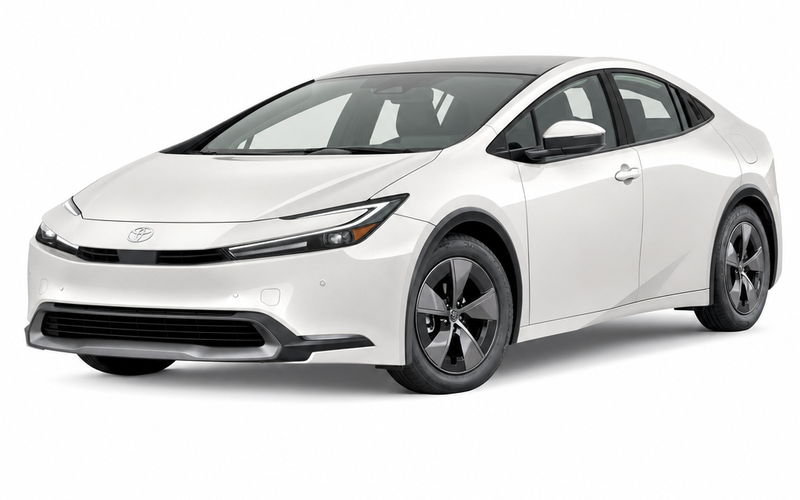
Toyota Prius: the efficiency benchmark that traded bland for bold
For two decades the Prius defined fuel-sipping practicality, and the current generation keeps that mission while adding a genuinely sharp design and real driving dynamics. In the compact hybrid segment it squares off against the Honda Civic Hybrid, Hyundai Elantra Hybrid, and Kia Niro, yet no competitor matches its combination of up to 57 mpg combined and available all-wheel drive. The main reason to consider it is simple: it delivers class-leading economy without forcing you to accept a penalty box interior or sluggish acceleration.
Why consider Toyota Prius
The Prius is no longer just the sensible choice; it is now one of the more satisfying cars in the compact class. The fifth-generation hybrid system produces up to 196 net horsepower, enough to reach 60 mph in about 7.0 seconds in AWD form, which puts it ahead of the Honda Civic Hybrid in straight-line urgency. The low-mounted battery gives it a planted feel that makes commuting genuinely pleasant rather than merely efficient.
- Up to 57 EPA-estimated combined mpg, among the best in any non-plug-in hybrid sold in the U.S.
- Available Electronic On-Demand All-Wheel Drive, a rarity in this segment outside of Subaru models
- 23.8 cubic feet of cargo space behind the rear seats for a hatchback of its size
- Standard Toyota Safety Sense suite, including pre-collision warning and lane-keeping assist
- Distinctive low-slung styling that finally makes the hybrid look the part
Specifications and powertrains
2.0-liter hybrid (FWD and AWD): The sole gasoline powertrain for the U.S. market pairs a 2.0-liter four-cylinder with Toyota's fifth-generation Hybrid Synergy Drive, delivering up to 196 net combined horsepower. Front-drive models return an EPA-estimated 57 mpg combined, while the Electronic On-Demand AWD version still manages 54 mpg combined. Electric-only EV Mode covers low-speed, short-distance running, and Power Mode sharpens throttle response for highway merges.
Plug-in hybrid (Prius Prime): Offered separately as the Prius Prime, the plug-in variant adds a larger battery for meaningful electric-only range, cutting fuel use dramatically for daily city driving. Charging via a home outlet or public Level 2 station is straightforward, and the gasoline engine serves as a range extender for longer trips.
EPA estimates and powertrain packaging are published at fueleconomy.gov and in Toyota's 2026 Prius brochure here: https://www.toyota.com/content/dam/toyota/brochures/pdf/2026/prius_ebrochure.pdf
Payment reality
The 2026 Prius starts around $29,000 and climbs toward $37,000 for a loaded Limited with AWD, placing it slightly above the Honda Civic Hybrid and Hyundai Elantra Hybrid at the base level. Monthly payments hinge on trim choice, down payment, term, and prevailing interest rates, plus whether you lease or finance. Resale value matters here: the Prius holds its worth better than most compact hybrids thanks to strong demand and a reputation for durability, which lowers effective ownership cost even when the sticker looks steep.
Warranty and maintenance
Toyota covers the Prius with a 3-year/36,000-mile basic warranty and a 5-year/60,000-mile powertrain warranty, matching most mainstream rivals. The hybrid battery gets an 8-year/100,000-mile warranty, extended to 10 years/150,000 miles in California and other states with stricter emissions rules. Scheduled service is modest, with oil changes and tire rotations recommended at roughly 5,000 to 10,000-mile intervals. Toyota's dense U.S. dealer network and wide parts availability keep independent servicing straightforward and inexpensive relative to European rivals.
Who Toyota Prius suits
The Prius fits buyers who rack up high annual mileage, whether that means long highway commutes, daily urban errands, or rideshare work where fuel cost and reliability determine profit. Its 23.8-cubic-foot cargo bay and standard safety tech also suit small families and outdoor enthusiasts who want AWD grip without SUV fuel bills. If you prioritize a lower entry price, the Hyundai Elantra Hybrid undercuts it, while the Kia Niro offers similar economy in a taller crossover body; drivers who want a fun-to-drive conventional compact might prefer the Mazda3 sedan instead.
Frequently asked questions
The listed starting price for the Toyota Prius is 28 550.
Using the current calculator settings, the estimated payment for the Toyota Prius starts at 332 per month. Actual terms depend on the lender, credit, term, down payment, taxes, and fees.
The recorded catalog data lists these powertrains for the Toyota Prius:
Hybrid
Verify trim-level availability and efficiency ratings with the manufacturer or seller.
Emissions and efficiency vary by powertrain, trim, test method, and model year. Verify the applicable EPA ratings and any state-specific rules for the exact vehicle before purchase.
Contact a participating seller to ask about availability and schedule a test drive. Inventory and eligibility are controlled by the seller.
Warranty coverage varies by model year, trim, powertrain, original sale date, mileage, and market. Confirm the exact written warranty and remaining coverage with the manufacturer or seller.