
Toyota
Mirai


This estimate illustrates a vehicle lease. It is informational, not a financing offer or approval. Actual payments depend on negotiated price, residual value, money factor, mileage allowance, taxes, fees, credit, and lender terms.
This estimate illustrates vehicle financing. It is informational, not a credit offer or approval. Actual payments depend on purchase price, down payment, annual percentage rate, term, taxes, fees, credit, and lender terms.
This estimate illustrates a vehicle lease. It is informational, not a financing offer or approval. Actual payments depend on negotiated price, residual value, money factor, mileage allowance, taxes, fees, credit, and lender terms.
Toyota Mirai service offers offers
Toyota Mirai service offers offers
More
About this car
Hydrogen flagship: positioning the Toyota Mirai in a charging era
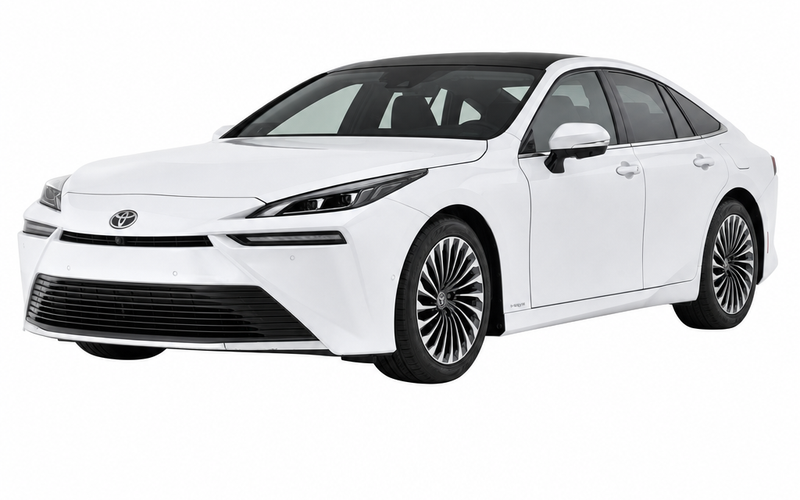
The Toyota Mirai is one of only two hydrogen fuel-cell sedans sold to retail buyers in the United States, sharing that niche with the Hyundai Nexo. Its core pitch is infrastructure-driven: refuel in roughly five minutes, drive up to 402 miles per fill, and produce only water as tailpipe output. For shoppers who live near operational hydrogen stations, the Mirai sidesteps the charging waits typical of battery-electric sedans while delivering a quiet, rear-wheel-drive ride that feels closer to a grand tourer than an eco commuter.
In a multi-brand comparison it lines up against the Nexo on hydrogen, and against EVs such as the Tesla Model 3 and Hyundai Ioniq 6 when buyers weigh refueling speed versus charging availability. https://www.toyota.com/mirai/
Why consider Toyota Mirai
The Mirai addresses the two biggest battery-EV complaints: range anxiety and charging time. The 2026 model carries an EPA-estimated 402-mile range, and a hydrogen fill takes about five minutes at a station rather than 30 minutes or more at a DC fast charger. Toyota also bundles a $15,000 complimentary fuel credit, valid for six years on purchases and three years on leases.
Compared with the Hyundai Nexo, the Mirai returns a longer range, a roomier five-seat cabin, and rear-wheel-drive handling that makes it noticeably more engaging to drive. Ride comfort is strong, road noise is low, and standard Toyota Safety Sense 3.0 includes Pre-Collision System with Pedestrian Detection, lane-keeping assistance, and adaptive cruise control.
- EPA-estimated 402-mile range on a full hydrogen fill
- Refueling time of roughly five minutes, close to gasoline
- $15,000 complimentary fuel credit included with purchase or lease
- Rear-wheel-drive platform with 182 horsepower and smooth, silent acceleration
- Spacious five-seat interior with premium materials and dual 12.3-inch displays
Specifications and powertrains
Hydrogen fuel cell (single powertrain): The Mirai is offered exclusively as a fuel-cell electric vehicle. A fuel-cell stack converts hydrogen from three high-pressure carbon-fiber-reinforced tanks into electricity, powering a rear-mounted electric motor rated at 182 horsepower. The only tailpipe output is water vapor, and the 2026 model achieves an EPA-estimated 402-mile driving range in XLE form; the Limited trim returns a lower range figure according to Toyota materials. https://www.toyota.com/content/dam/toyota/brochures/pdf/2026/mirai_brochure.pdf
Efficiency: EPA figures are expressed on the MPGe scale, generally landing in the mid-60s to mid-70s MPGe depending on trim and driving conditions. Because hydrogen is metered by weight rather than volume, real-world efficiency varies with ambient temperature and station pressure, and cold climates noticeably reduce range.
Emissions: The Mirai produces zero tailpipe emissions; only water exits the exhaust. Lifecycle emissions depend on hydrogen production method — gray hydrogen from natural gas versus green hydrogen from renewable sources.
Payment reality
The 2025-2026 Mirai sits in the mid-$49,000 to low-$52,000 MSRP band depending on trim, per Toyota pricing materials. That places it close to the Hyundai Nexo and above most midsize EV sedans. Monthly outlay is driven by the high sticker price plus a promotional fuel credit that only partially offsets hydrogen costs after the incentive period ends.
Depreciation is the sharper concern: hydrogen stations concentrate in California, so used-market demand is thin, and residuals typically trail battery EVs in the same price class. Leasing often fits better here because the manufacturer absorbs residual risk. https://www.toyota.com/mirai/
Warranty and maintenance
Toyota backs the Mirai with a 3-year/36,000-mile basic warranty and a 5-year/60,000-mile powertrain warranty. Key fuel-cell components — the air compressor, boost converter, and hydrogen tanks — carry an 8-year/100,000-mile warranty, while the hybrid battery is covered 10 years or 150,000 miles. ToyotaCare adds no-cost scheduled maintenance for 3 years or 35,000 miles plus 24-hour roadside assistance for 3 years, unlimited mileage.
With few moving parts, scheduled service is minimal — brake fluid and cabin-air filter changes dominate the routine list. Parts availability is thin outside California, and independent shops are scarce, so most owners rely on Toyota dealers. https://www.toyota.com/content/dam/toyota/brochures/pdf/2026/mirai_brochure.pdf
Who Toyota Mirai suits
The Mirai fits commuters who live or work within range of an operational hydrogen station, effectively the southern and northern California corridors, and who value five-minute refueling over plug-in habits. It also suits households wanting a zero-emission car without base-EV range anxiety, and drivers who prefer a conventional premium sedan layout over a crossover.
Buyers without hydrogen access should consider the Hyundai Nexo (same infrastructure constraint), the Tesla Model 3, or the Hyundai Ioniq 6 if they can tolerate charging time. If you are in the hydrogen corridor and want a distinctive, quiet sedan, the Mirai earns a test drive.