K

Subaru
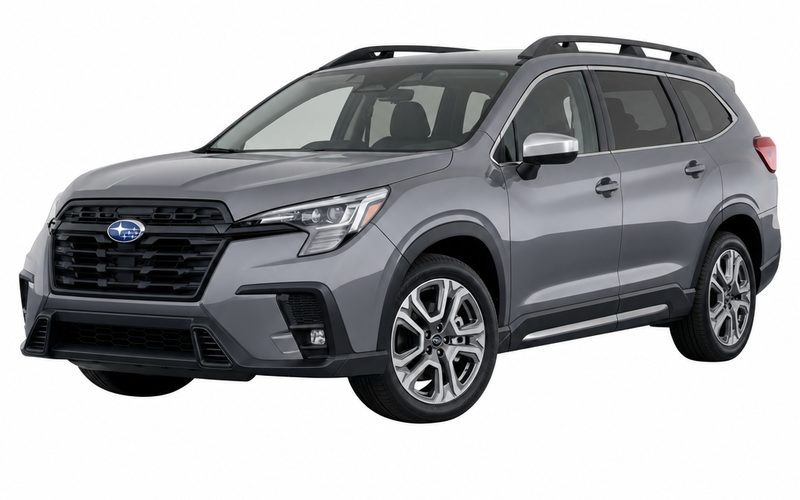
Ascent
Purchase price from $40,795
from
$474
per month
per mo.


This estimate illustrates a vehicle lease. It is informational, not a financing offer or approval. Actual payments depend on negotiated price, residual value, money factor, mileage allowance, taxes, fees, credit, and lender terms.
This estimate illustrates vehicle financing. It is informational, not a credit offer or approval. Actual payments depend on purchase price, down payment, annual percentage rate, term, taxes, fees, credit, and lender terms.
This estimate illustrates a vehicle lease. It is informational, not a financing offer or approval. Actual payments depend on negotiated price, residual value, money factor, mileage allowance, taxes, fees, credit, and lender terms.
from
$474
per month
per mo.
New
New Subaru Ascent offers
Used
Used Subaru Ascent offers
Services
Subaru Ascent service offers
Maintenance
Subaru Ascent maintenance offers
New Subaru Ascent offers
New Subaru Ascent offers
There are no featured offers for the Subaru Ascent right now. Send a request to receive a personalized offer.
Compare with similar cars
See how Subaru Ascent compares with similar cars on price, payment, and specifications.
About this car
Subaru
Ascent
How far do you drive each year?
MI
Fuel:
Gasoline
Fuel economy:
21.5 mpg
CO₂ emissions:
406 g/mi
Annual fuel cost:
$17
Subaru Ascent Positioning: The Standard-AWD Three-Row Family Crossover
The Subaru Ascent sits in the crowded US three-row crossover segment alongside the Toyota Highlander, Kia Telluride, and Hyundai Palisade. Its defining angle is standard equipment: every trim level pairs Subaru's Symmetrical All-Wheel Drive with a 260-horsepower 2.4-liter turbocharged engine, something few direct rivals offer as standard across the lineup. With seating for seven or eight and 5,000 pounds of towing capacity, the Ascent covers family shuttling and light trailering in one package. It is assembled in Lafayette, Indiana, which supports parts availability and dealer logistics across the United States.
Why Consider the Subaru Ascent
Compared with the Kia Telluride, the Ascent leans harder into built-in all-weather capability. Standard AWD and 8.7 inches of ground clearance mean you do not pay extra for a drivetrain upgrade just to handle snow or dirt roads. The interior is practical, with 19 cup holders, up to 153.2 cubic feet of passenger space, and cargo volume that grows from 17.8 to 75.6 cubic feet with rear seats folded. Subaru reports that 96% of vehicles it sold in the last decade are still on the road, a durability signal long-term owners care about.
Three strengths stand out against the competition:
- Standard AWD on every trim — the Toyota Highlander makes AWD optional on several trims.
- Third-row legroom — more than the Kia Telluride and Hyundai Palisade, per Subaru's published comparison.
- 5,000-pound towing — class-competitive and useful for a small boat or trailer.
- Value packaging — EyeSight driver assistance, a power liftgate, and an 11.6-inch touchscreen come standard on the base Premium trim.
Specifications and Powertrains
Gasoline engine. The Ascent offers one powertrain across all trims: a 2.4-liter turbocharged SUBARU BOXER four-cylinder with direct injection, rated at 260 horsepower. It runs on regular 87-octane unleaded gasoline, and power flows through a continuously variable automatic transmission to all four wheels via Symmetrical All-Wheel Drive. EPA fuel economy figures are published per model year and typically land in the low-20s combined mpg, which trails hybrid rivals such as the Toyota Highlander Hybrid. Full specifications are in the 2026 brochure at https://www.subaru.com/content/dam/subaru/downloads/pdf/brochures/2026/2026_Ascent_Brochure_121825.pdf.
With 8.7 inches of ground clearance, up to 5,000 pounds of towing capacity, and roof rails rated for a 700-pound static load, the Ascent is one of the more capable choices in its class for light-duty hauling and camping duty. There is no plug-in hybrid or electric variant offered in the US market.
Payment Reality for the Subaru Ascent
MSRP for the 2026 Ascent starts in the high-$30,000 range and climbs past $48,000 on top Touring trims (see the pricing page at https://www.subaru.com/vehicles/ascent/2026.html). Monthly payments depend on trim, term, interest rate, and down payment, but two factors matter most. First, Subaru's AWD-standard packaging keeps base prices honest — there is no hidden drivetrain upcharge. Second, the Ascent historically holds value in line with other mainstream three-row SUVs, though it typically trails the Kia Telluride on long-term residual performance. A longer loan term lowers the monthly figure but adds interest; use the CarPayCheck calculator to model your own numbers.
Warranty and Maintenance
Subaru covers the Ascent with a 3-year/36,000-mile basic warranty, a 5-year/60,000-mile powertrain warranty, and 3-year/36,000-mile roadside assistance. Scheduled maintenance intervals run roughly every 6,000 miles, and the turbocharged engine runs on regular gasoline, which keeps per-mile running costs moderate. Built at the Lafayette, Indiana plant, the Ascent benefits from a dense US dealer network, so factory parts are typically available quickly. Independent shops and Subaru specialists are common nationwide, offering a cheaper service alternative once the factory maintenance plan expires.
Who the Subaru Ascent Suits
The Ascent fits families that need three usable rows, live in snow-belt states or on unpaved roads, and tow small boats or campers. It also suits buyers who want a no-drama ownership experience with standard safety technology and a reputation for longevity. If sharper styling and the strongest resale value matter more, the Kia Telluride is the better draw; if fuel economy tops your list, the Toyota Highlander Hybrid delivers far better MPG. The Ascent occupies the pragmatic middle: competent, honest, and ready to work. City commuters who rarely carry passengers or cargo will find smaller, cheaper crossovers more efficient.
Frequently asked questions
The listed starting price for the Subaru Ascent is 40 795.
Using the current calculator settings, the estimated payment for the Subaru Ascent starts at 474 per month. Actual terms depend on the lender, credit, term, down payment, taxes, and fees.
The recorded catalog data lists these powertrains for the Subaru Ascent:
Gasoline
Verify trim-level availability and efficiency ratings with the manufacturer or seller.
Emissions and efficiency vary by powertrain, trim, test method, and model year. Verify the applicable EPA ratings and any state-specific rules for the exact vehicle before purchase.
Contact a participating seller to ask about availability and schedule a test drive. Inventory and eligibility are controlled by the seller.
Warranty coverage varies by model year, trim, powertrain, original sale date, mileage, and market. Confirm the exact written warranty and remaining coverage with the manufacturer or seller.