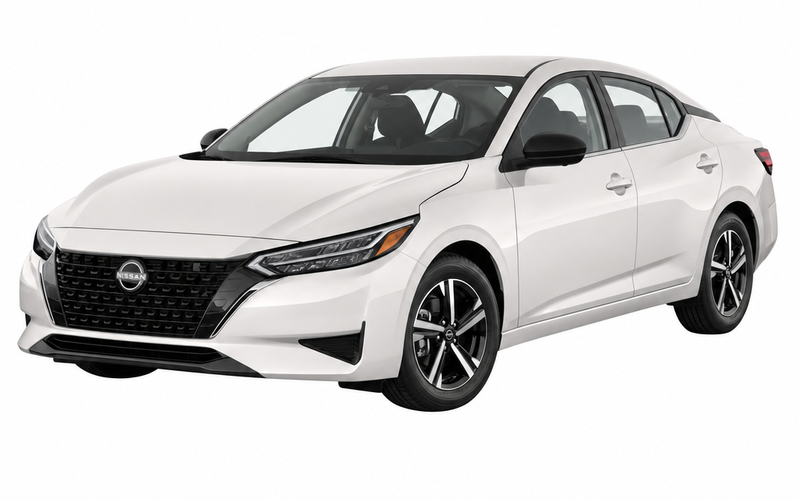
Nissan Sentra Positioning: A Value-First Compact Sedan With a Refined Cabin
The 2026 Nissan Sentra competes in the US compact sedan segment against the Honda Civic, Toyota Corolla, and Hyundai Elantra. Its positioning: a comfortable, well-equipped commuter that undercuts several rivals on price while adding a more refined interior and a longer standard safety list. The base S trim starts at $22,990; the range-topping SL is $27,990. https://www.nissanusa.com/vehicles/cars/sentra/specs-trims.html
The main reason to consider the Sentra is the balance between price and equipment. It does not chase the Civic's driving dynamics or the Corolla's hybrid efficiency. Instead, it focuses on a quiet ride, a roomy cabin, and technology that is easy to live with daily.
Why Consider the Nissan Sentra
The Sentra's core appeal is value without obvious cheapness. The 2026 model gains a bolder exterior, upgraded interior materials, and larger dual displays on higher trims. Compared with the Honda Civic, it is less engaging to drive, but it counters with a softer ride and a lower starting price.
The SR trim adds an independent rear suspension, drive modes (Normal, Sport, Eco), and available ProPILOT Assist, which helps with stop-and-go highway traffic. For buyers who spend significant time commuting, that combination matters more than raw performance.
- Standard Safety Shield 360 includes Automatic Emergency Braking with Pedestrian Detection, Blind Spot Warning, and Rear Cross Traffic Alert.
- Up to 38 mpg highway from the 2.0-liter four-cylinder. https://www.nissanusa.com/vehicles/cars/2026-sentra.html
- Available ProPILOT Assist eases highway and stop-and-go driving.
- Wireless Apple CarPlay and Android Auto come standard, with available wireless charging.
- A wide trunk opening and 60/40-split folding rear seats add practicality.
Nissan Sentra Specifications and Powertrains
Gasoline engine: Every 2026 Sentra uses a 2.0-liter four-cylinder producing 145 horsepower and 145 lb-ft of torque, paired with a continuously variable automatic transmission (CVT) driving the front wheels. Highway fuel economy is rated up to 38 mpg depending on trim, and all versions run on regular unleaded gasoline. SR trims add Normal, Sport, and Eco drive modes that adjust throttle response and transmission behavior. https://www.nissanusa.com/vehicles/cars/2026-sentra.html
Emissions and alternatives: Nissan offers no hybrid or electric Sentra for the US market. Buyers who want a low-emissions compact sedan should cross-shop the Toyota Corolla Hybrid or Hyundai Elantra Hybrid. The Sentra's conventional powertrain keeps the purchase price down, but it will not match the fuel economy of those electrified alternatives.
Nissan Sentra Payment Reality
The Sentra's $22,990 to $27,990 MSRP range puts it on the affordable end of the compact sedan class. https://www.nissanusa.com/vehicles/cars/sentra/specs-trims.html Your monthly payment depends on down payment, loan term, interest rate, and trim choice. Because the Sentra tends to depreciate faster than the Honda Civic and Toyota Corolla, financing buyers should watch loan-to-value ratios, while lessees should verify residual values before signing. Use the payment calculator on this page to model your own figures rather than relying on advertised monthly specials.
Nissan Sentra Warranty and Maintenance
Nissan covers the Sentra with a 3-year/36,000-mile basic warranty and a 5-year/60,000-mile powertrain warranty, which is typical for the compact sedan segment. Scheduled maintenance follows a 5,000-mile interval, with oil changes, tire rotations, and multi-point inspections. Parts are widely available across the US, so owners can choose between Nissan dealers and independent shops. The CVT fluid service should follow the manufacturer's recommended interval to avoid expensive transmission issues later.
Who the Nissan Sentra Suits
The Sentra fits buyers who want a fuel-efficient, well-equipped compact sedan for daily commuting and highway miles, with a comfortable cabin and a low entry price. It is a sensible pick for first-time new-car buyers, rideshare drivers, and anyone who prioritizes running costs over driving excitement. If you want sharper handling, consider the Honda Civic or Mazda3; if a hybrid powertrain matters more, the Toyota Corolla Hybrid is the honest alternative. The Sentra's value proposition is strongest for those who plan to keep the car long-term and service it on schedule.