
Mitsubishi
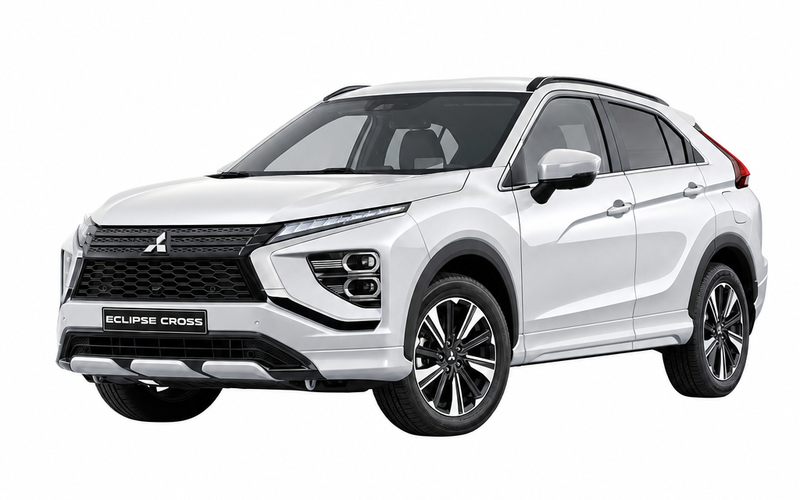
Eclipse Cross


This estimate illustrates a vehicle lease. It is informational, not a financing offer or approval. Actual payments depend on negotiated price, residual value, money factor, mileage allowance, taxes, fees, credit, and lender terms.
This estimate illustrates vehicle financing. It is informational, not a credit offer or approval. Actual payments depend on purchase price, down payment, annual percentage rate, term, taxes, fees, credit, and lender terms.
This estimate illustrates a vehicle lease. It is informational, not a financing offer or approval. Actual payments depend on negotiated price, residual value, money factor, mileage allowance, taxes, fees, credit, and lender terms.
Mitsubishi Eclipse Cross maintenance offers offers
Mitsubishi Eclipse Cross maintenance offers offers
More
About this car
2026 Mitsubishi Eclipse Cross: Compact Crossover Positioning for Practical Buyers
The Mitsubishi Eclipse Cross occupies the compact crossover segment alongside the Honda CR-V, Toyota RAV4, and Mazda CX-5, but it distinguishes itself with a lower entry price and standard all-wheel drive hardware. Mitsubishi positions it as the value-oriented pick in the class, pairing a modestly sized turbocharged engine with the brand's Super All-Wheel Control system as standard equipment across every trim. For shoppers who prioritize predictable ownership costs and all-weather traction over outright interior space or towing muscle, the Eclipse Cross presents a straightforward, no-frills alternative that competes more on price per feature than on badge prestige.
Its sloping roofline and rear hatch give it a sportier silhouette than boxier rivals, yet the cabin capacity stays firmly in mainstream compact territory. The core argument for considering it is simple: you get a turbocharged AWD compact SUV with a class-leading warranty for less than most front-wheel-drive versions of its Japanese competitors.
Why Consider the Mitsubishi Eclipse Cross
The Eclipse Cross earns serious consideration primarily on value and standard equipment. Where the Honda CR-V requires stepping up to higher trim levels for all-wheel drive, the Eclipse Cross makes its S-AWC system standard on every US-market version, which matters for drivers in snow-belt states. The warranty package — a 10-year/100,000-mile powertrain limited warranty — remains the longest in the mainstream compact segment and directly addresses long-term ownership anxiety.
The 1.5-liter turbocharged four-cylinder delivers adequate around-town response rather than class-leading punch, and ride quality leans toward comfort over sport, which aligns with its intended audience. Compared with a Mazda CX-5, the Eclipse Cross gives up some steering feel and premium cabin materials, but undercuts it on starting price and warranty coverage.
- Standard Super All-Wheel Control on every trim, including selectable Auto, Snow, and Gravel drive modes
- 10-year/100,000-mile powertrain limited warranty, unmatched among mainstream compact crossovers
- Up to 2,000 pounds of towing capacity, useful for small trailers and jet skis
- Turbocharged efficiency with EPA combined ratings of 26 mpg on most trims
- Forward Collision Mitigation, Lane Departure Warning, and Automatic High Beams as standard safety tech
Specifications and Powertrains for the US Market
Gasoline engine. Every 2026 Eclipse Cross sold in the United States uses a 1.5-liter direct-injection turbocharged four-cylinder producing 152 horsepower and 184 lb-ft of torque, paired exclusively with a continuously variable transmission that offers an 8-speed Sport Mode with paddle shifters. There is no hybrid or plug-in variant in the US lineup, so buyers seeking electrified options should look instead at the Hyundai Tucson Hybrid or Toyota RAV4 Hybrid.
EPA fuel economy. The base ES trim is rated at 25 mpg city and 28 mpg highway, while LE, SE, and SEL trims return 25 mpg city and 26 mpg highway, with a combined figure of 26 mpg across the range. These numbers trail the most efficient hybrid rivals but are respectable for a standard-AWD compact crossover running on regular fuel.
All trims seat five occupants, and the SEL Touring adds the hands-free power liftgate and larger infotainment display. No diesel or alternative-fuel options exist in this market.
Eclipse Cross Payment Reality: What Drives the Monthly Cost
Monthly payments on an Eclipse Cross are influenced first by the transaction price — the base ES trim starts near $28,000 including destination, positioning it below most all-wheel-drive competitors — and second by how the vehicle holds value over time. Mitsubishi models historically depreciate faster than Honda or Toyota crossovers, which lowers monthly lease payments because the residual value is set more conservatively, but it also means financed buyers carry more negative equity risk if they trade in early. The warranty does not eliminate depreciation; it only reduces out-of-pocket repair risk during the ownership period. Use the CarPayCheck payment calculator with your real down payment, term, and interest rate to see the actual monthly figure for your situation.
Warranty and Maintenance: Mitsubishi Eclipse Cross Coverage
Mitsubishi backs the 2026 Eclipse Cross with a 5-year/60,000-mile new vehicle limited warranty and a 10-year/100,000-mile powertrain limited warranty that transfers to subsequent owners, a transferability advantage few competitors match. Anti-corrosion coverage extends to 7 years/100,000 miles, and roadside assistance is included for 5 years with unlimited mileage. Scheduled maintenance intervals follow the standard 5,000-mile oil-change cycle, and parts availability is solid nationwide through Mitsubishi dealerships. Independent shops can service the 1.5-liter turbo without special tooling, though S-AWC system work and warranty-covered repairs are best handled at a dealer to preserve coverage terms.
Who the Mitsubishi Eclipse Cross Suits Best
The Eclipse Cross fits first-time SUV buyers, households on a firm budget, and drivers in regions with heavy snow or gravel roads who want the security of standard all-wheel drive without paying a premium for it. It also suits buyers who plan to own the vehicle past the loan term and value the 10-year powertrain safety net. It is less ideal for those needing maximum cargo volume or third-row flexibility — the Honda CR-V and Subaru Outback offer more usable space. If fuel economy is the priority, the Toyota RAV4 Hybrid is the better call; if driving dynamics matter most, the Mazda CX-5 remains the sharper handler. Trade-offs acknowledged, the Eclipse Cross rewards buyers who count standard features and warranty length more heavily than brand cachet.