
Mazda
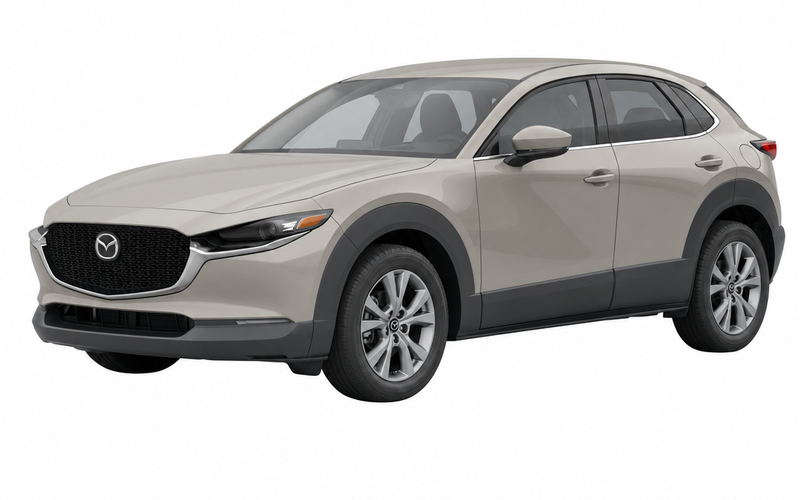
CX-30


This estimate illustrates a vehicle lease. It is informational, not a financing offer or approval. Actual payments depend on negotiated price, residual value, money factor, mileage allowance, taxes, fees, credit, and lender terms.
This estimate illustrates vehicle financing. It is informational, not a credit offer or approval. Actual payments depend on purchase price, down payment, annual percentage rate, term, taxes, fees, credit, and lender terms.
This estimate illustrates a vehicle lease. It is informational, not a financing offer or approval. Actual payments depend on negotiated price, residual value, money factor, mileage allowance, taxes, fees, credit, and lender terms.
Mazda CX-30 maintenance offers offers
Mazda CX-30 maintenance offers offers
More
About this car
Mazda CX-30: Premium-Feeling Compact Crossover Without the Premium Badge
The Mazda CX-30 sits at the higher end of the subcompact crossover segment, positioned between smaller offerings like the Honda HR-V and the more family-oriented Toyota Corolla Cross. It is a style-first, driver-focused crossover that borrows the upscale cabin approach of Mazda's larger CX-50. Its core argument is straightforward: you get a premium-feeling interior, a polished powertrain, and sharp handling in a package that stays easy to park in the city. The trade-offs are a tighter rear seat and less cargo volume than most rivals in its class.
Why Consider the Mazda CX-30
Buyers who find the Honda HR-V practical but unremarkable, or the Toyota Corolla Cross efficient but bland, will find the CX-30 a more engaging alternative. Its standard 2.5-liter engine makes more power than the base engines in most segment rivals, and the available turbocharged version pushes performance well beyond what this category usually offers. Interior materials and the standard driver-assistance suite also feel a step above the class average.
What sets it apart in daily use is the driving position and control layout. Mazda's human-centric design places the pedals, steering wheel, and displays where your body naturally expects them, reducing fatigue on longer commutes. The ride is firmer than the Corolla Cross, but the payoff is more precise steering and better body control through corners.
Distinct strengths include:- Generous standard power: the 2.5-liter four-cylinder develops 191 horsepower, well ahead of the base engines in most competitors.
- Available i-Activ all-wheel drive, which works with G-Vectoring Control Plus to distribute torque based on grip and steering inputs.
- An upscale cabin with soft-touch materials and a rationally organized, driver-focused layout that rivals costlier vehicles.
- Strong crash-test results and a full i-Activsense safety suite as standard equipment.
- Wireless Apple CarPlay and Android Auto connectivity on most trims.
Specifications and Powertrains
Gasoline — 2.5-liter Skyactiv-G inline-four. The standard engine produces 191 horsepower and 186 lb-ft of torque, paired with a six-speed automatic transmission. Front-wheel drive is standard; i-Activ AWD is optional on base trims and standard on higher grades. EPA-rated fuel economy is approximately 26 mpg city and 33 mpg highway for FWD models, and about 25 mpg city and 32 mpg highway for AWD versions.
Gasoline Turbo — 2.5-liter Skyactiv-G turbocharged inline-four. Available on upper trims, this engine produces 250 horsepower and 320 lb-ft of torque on premium fuel, with slightly lower output on regular gasoline. It pairs exclusively with AWD. EPA estimates are roughly 22 mpg city and 30 mpg highway.
Payment Reality: What Drives the Monthly Figure
The CX-30's current model year starts around $25,000 for the base 2.5 S trim and climbs above $35,000 for the loaded Turbo Premium Plus. This places it at the premium end of the subcompact segment, so monthly payments will track closer to a compact SUV than to a value-oriented crossover. Residual values have held up reasonably well, partly because Mazda builds the CX-30 in lower volumes than Honda or Toyota produce their competitors. This stability influences lease terms, but the exact payment depends on down payment, loan term, and interest rate. Use the payment calculator to model your specific figure.
Warranty and Maintenance
Mazda covers the CX-30 with a 3-year/36,000-mile basic warranty and a 5-year/60,000-mile powertrain warranty. That matches the industry standard set by Toyota and Honda, though it is shorter than the 5-year/60,000-mile basic coverage Hyundai offers on the Kona. Scheduled maintenance intervals run about every 7,500 miles for oil changes, with cabin and engine air filters typically due between 15,000 and 30,000 miles. Mazda dealers are well represented across the United States, and the CX-30 shares its engine and platform with the Mazda 3 and CX-50, which keeps parts availability strong. Independent shops comfortable with Mazda's Skyactiv engines can handle routine service at lower labor rates.
Who the Mazda CX-30 Suits
The CX-30 fits single drivers, couples, and small families who prioritize driving enjoyment and interior quality over maximum passenger or cargo space. It works well for daily commuters who want a car that feels more expensive than it is, and for city dwellers who need a compact footprint with AWD capability for winter months. Buyers who frequently carry rear-seat passengers or need generous cargo capacity should consider the Toyota Corolla Cross or Honda HR-V instead. Budget-focused shoppers may find the Hyundai Kona or Kia Seltos offer comparable feature content for less, though neither delivers the same powertrain refinement or cabin quality.