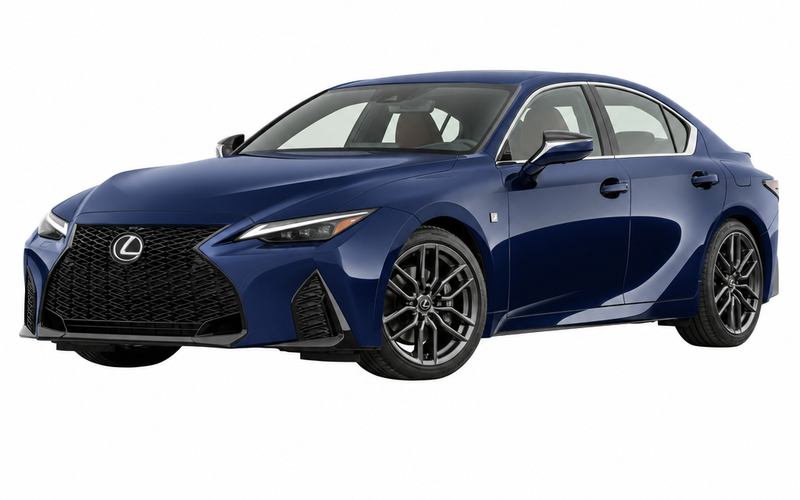
The IS holds the line for rear-wheel-drive sports sedans
The Lexus IS is the compact luxury sedan that refused to follow the segment's migration toward turbocharged four-cylinders and front-drive platforms. Where the BMW 3 Series and Mercedes-Benz C-Class have downsized engines and softened their chassis tuning, the IS keeps a rear-wheel-drive layout, a double-wishbone front suspension, and — in its flagship form — a naturally aspirated 5.0-liter V8. It competes directly with the Acura TLX and Genesis G70, but no rival offers a V8. Since its debut in 1999, the IS has been positioned as the enthusiast's pick within Lexus's lineup, and the current generation sharpens that focus with F Sport trims and the IS 500 F Sport Performance variant.
Why consider the Lexus IS
The IS stands out for preserving driving engagement in a segment where most competitors have prioritized efficiency over feel. Its platform, tuned at Toyota's Shimoyama test course, delivers steering response and body control that the Audi A4 and C-Class struggle to match. The IS 500 adds a 472-horsepower V8, a configuration no other compact luxury sedan offers, making it a singular choice for buyers who want old-school muscle with modern refinement. Lexus also fits every IS with the Safety System+ suite, including Emergency Steering Assist and Lane Tracing Assist (https://discoverlexus.com/models/is/).
- The only V8-powered compact luxury sedan in the United States (IS 500)
- Rear-wheel drive standard, with available all-wheel drive on four-cylinder and V6 models
- Double-wishbone front suspension, tuned for handling precision rather than comfort-first compliance
- Lexus reliability record and strong dealer network, reducing long-term ownership risk
- Distinctive, aggressive exterior design that separates it from the conservative Lexus ES
Specifications and powertrains
IS 300 (turbocharged four-cylinder)
A 2.0-liter turbocharged four-cylinder produces 241 horsepower and is available with rear-wheel drive. EPA-rated fuel economy ranges from approximately 22-32 mpg depending on configuration, the most efficient option in the lineup.
IS 300 AWD (V6)
All-wheel-drive IS 300 models use a 3.5-liter V6 rated at 260 horsepower (https://www.lexus.com/content/dam/lexus/documents/brochures/models/2025/MY25-Lexus-IS-Brochure.pdf). Expect fuel economy around 20-28 mpg.
IS 350
The 3.5-liter V6 in the IS 350 produces 311 horsepower and is offered with either rear- or all-wheel drive. Fuel economy is approximately 19-28 mpg depending on drivetrain.
IS 500 F Sport Performance
A 5.0-liter V8 rated at 472 horsepower sits at the top of the range, available only with rear-wheel drive. It is the most powerful IS ever sold in the United States, with fuel economy near 17-25 mpg.
Payment reality
The 2025 Lexus IS starts around $41,000 for the IS 300 and rises past $60,000 for a fully loaded IS 500 (https://www.lexus.com/content/dam/lexus/documents/brochures/models/2025/MY25-Lexus-IS-Brochure.pdf). Because the IS holds its value better than most German competitors — Lexus vehicles historically depreciate slower than BMW or Audi models — your monthly payment is offset by stronger resale when you sell or trade. The IS 500 is a limited-production model, so its used-market pricing tends to stay firm, while the IS 300 and IS 350 follow more predictable depreciation curves. Use the CarPayCheck calculator with your local tax rate, down payment, and term to see how these factors affect your specific payment.
Warranty and maintenance
Lexus backs every new IS with a 4-year/50,000-mile basic warranty and 6-year/70,000-mile powertrain coverage. Scheduled maintenance intervals are set at 10,000 miles or 12 months, whichever comes first. Parts availability in the United States is strong, given the IS shares its powertrains with other Lexus and Toyota models. Routine service — oil changes, brake pads, tires — runs slightly higher than mainstream sedans but below most German rivals. Independent shops familiar with Toyota/Lexus engineering can handle most non-warranty work, though the IS 500's V8 and adaptive dampers are best left to dealers or specialists.
Who Lexus IS suits
The IS fits buyers who prioritize driving dynamics over rear-seat space or cargo volume — its interior is tighter than the ES or BMW 3 Series. It suits daily commuters who want engagement on the way to work, weekend canyon drivers, and enthusiasts who want V8 power without German maintenance costs. If rear legroom is a priority, consider the Genesis G70 or Acura TLX, which offer comparable performance with more usable back seats. If fuel economy matters more than handling, the Audi A4 or a hybrid sedan would serve you better. The IS is a focused product, and it rewards buyers who know exactly why they want it.