
Jeep
Recon


This estimate illustrates a vehicle lease. It is informational, not a financing offer or approval. Actual payments depend on negotiated price, residual value, money factor, mileage allowance, taxes, fees, credit, and lender terms.
This estimate illustrates vehicle financing. It is informational, not a credit offer or approval. Actual payments depend on purchase price, down payment, annual percentage rate, term, taxes, fees, credit, and lender terms.
This estimate illustrates a vehicle lease. It is informational, not a financing offer or approval. Actual payments depend on negotiated price, residual value, money factor, mileage allowance, taxes, fees, credit, and lender terms.
Used Jeep Recon offers
Used Jeep Recon offers
About this car
Positioning: The Jeep Recon Claims the Electric Off-Road Slot No Rival Currently Holds
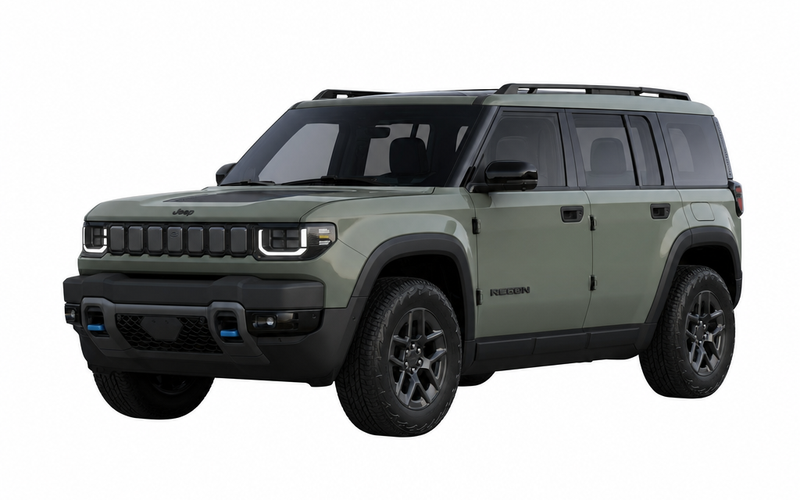
The 2026 Jeep Recon is a battery-electric midsize SUV that occupies a segment nobody else fills right now: a Trail Rated off-roader with removable doors and open-air body panels. Jeep prices it above the Wrangler on technology and MSRP, but below the massive GMC Hummer EV on size and cost. Its closest alternatives are the gasoline Ford Bronco and the electric Rivian R1S, both off-road capable but with different trade-offs in body style, range, and price. If zero-emission trail driving matters, the Recon is currently the only factory answer. (Source: https://www.jeep.com/recon.html)
Why Consider the Jeep Recon: Trail Hardware Without a Gasoline Engine
The Recon's core argument is that electric propulsion doesn't mean sacrificing off-road gear. It arrives with dual electric drive modules, an electronic rear locker, skid plates, and a Trail Rated badge — the first fully electric vehicle to earn one. Jeep quotes 24 inches of water-fording depth and Rough Road Cruise Control, features the Ford Bronco matches but the Rivian R1S does not offer in the same form. Against the Bronco, its edge is instant torque: 620 lb-ft from a standstill. Against the R1S, it counters with a lower entry price and a more open-air body. (Source: https://www.jeep.com/recon.html)
- Trail Rated capability, zero tailpipe emissions
- Removable doors, quarter glass, and swing-gate glass
- 650–670 hp and 620 lb-ft of torque
- Up to 230 miles of estimated range
- 3,500-lb max towing capacity
Specifications and Powertrains: The Recon's Single Electric Setup
Electric drivetrain. The Recon is sold exclusively as a battery-electric vehicle in the United States. Power comes from dual 250-kW electric drive modules, one per axle, fed by a 400-volt, 100.5-kWh battery pack. Jeep's official brochure quotes 650 horsepower and 620 lb-ft of torque, while some 2026 marketing materials cite 670 horsepower. Jeep estimates 0–60 mph in 3.6 seconds. (Source: https://cdn.dealereprocess.org/cdn/brochures/jeep/2026-recon.pdf)
Efficiency and charging. Estimated efficiency is up to 80 MPGe combined (91 city, 70 highway). DC fast charging moves the pack from 20% to 80% in about 28 minutes; a Level 2 home charger needs roughly 6.8 hours for the same window.
Range and payload. Estimated range is up to 230 miles. Curb weight is about 6,112 lb, maximum payload is 850 lb, and towing tops out at 3,500 lb when properly equipped.
Payment Reality: What Drives the Jeep Recon's Monthly Cost
Starting MSRP for the 2026 Jeep Recon is $66,995, and a well-equipped example lands near $69,585 before taxes and registration (Source: https://www.jeep.com/recon.html). That puts it above a base Ford Bronco and below a loaded Rivian R1S. Your actual monthly payment depends on down payment, loan term, trade-in value, and lease versus finance terms — the CarPayCheck calculator is the right tool for a precise figure. Depreciation matters more here than on a mainstream crossover: this is a first-generation EV in a niche segment, so resale values are unproven. Electric off-roaders like the GMC Hummer EV have shown uneven value retention, which is worth weighing before committing to a long loan.
Warranty and Maintenance: Standard EV Terms, Lighter Service Schedule
Jeep's new-vehicle warranty covers the Recon for 3 years or 36,000 miles bumper-to-bumper, with powertrain coverage extending to 5 years or 60,000 miles. The battery pack carries the typical US-market EV coverage of 8 years or 100,000 miles. Scheduled maintenance is lighter than on a gasoline SUV: no oil changes, with the main items being tire rotations, brake fluid checks, cabin air filter replacement, and wiper blade swaps. Jeep's nationwide dealer network handles warranty work, and parts availability should be strong given the brand's US footprint. Independent EV repair shops are still uncommon, so budget for dealer service during the warranty period.
Who the Jeep Recon Suits: Trail Enthusiasts Who Want Open-Air Electric Motoring
The Recon fits buyers who want genuine off-road capability without a gasoline engine and who value open-air driving — removable doors and glass are not available on the Rivian R1S or the GMC Hummer EV. It also works for households that need five seats and 3,500 lb of towing for a small trailer, boat, or off-road toys. If you rarely leave pavement, the Ford Bronco costs less to buy and the Kia EV9 rides smoother for daily driving. If you need three rows or more than 230 miles of range, the Rivian R1S is the stronger alternative. The Recon is a specialist tool, and it suits buyers who know they want exactly that.
Frequently asked questions
Emissions and efficiency vary by powertrain, trim, test method, and model year. Verify the applicable EPA ratings and any state-specific rules for the exact vehicle before purchase.
Contact a participating seller to ask about availability and schedule a test drive. Inventory and eligibility are controlled by the seller.
Warranty coverage varies by model year, trim, powertrain, original sale date, mileage, and market. Confirm the exact written warranty and remaining coverage with the manufacturer or seller.