Honda
Ridgeline


This estimate illustrates a vehicle lease. It is informational, not a financing offer or approval. Actual payments depend on negotiated price, residual value, money factor, mileage allowance, taxes, fees, credit, and lender terms.
This estimate illustrates vehicle financing. It is informational, not a credit offer or approval. Actual payments depend on purchase price, down payment, annual percentage rate, term, taxes, fees, credit, and lender terms.
This estimate illustrates a vehicle lease. It is informational, not a financing offer or approval. Actual payments depend on negotiated price, residual value, money factor, mileage allowance, taxes, fees, credit, and lender terms.
Honda Ridgeline maintenance offers offers
Honda Ridgeline maintenance offers offers
More
About this car
Honda Ridgeline: The Unibody Alternative in the Midsize Pickup Segment
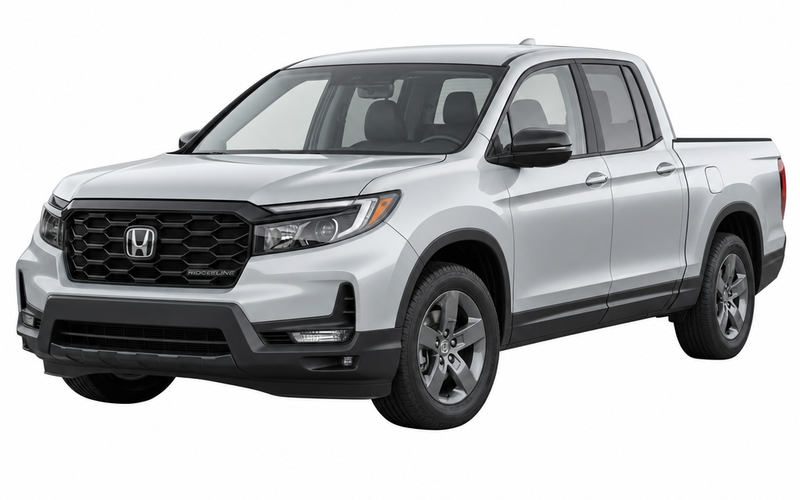
The Honda Ridgeline occupies a distinct position in the United States midsize pickup class as the only mainstream unibody truck among body-on-frame rivals such as the Toyota Tacoma and Ford Ranger. That structural difference delivers tangible benefits: a smoother, quieter ride on pavement, improved cabin space, and unique cargo features like the lockable In-Bed Trunk and dual-action tailgate that no direct competitor replicates. With a 5,000-pound towing capacity and standard all-wheel drive, it covers the practical needs of most light-duty truck buyers while avoiding the ride harshness and cabin noise typical of traditional ladder-frame pickups.
Why Consider the Honda Ridgeline
The Ridgeline's core appeal is its split personality as a comfortable family hauler and a genuinely useful truck. Its independent front and rear suspension and unibody construction give it ride quality closer to an SUV than to the Chevrolet Colorado or Nissan Frontier, which still exhibit noticeable rear-axle movement on rough pavement. The cabin seats five adults comfortably, with a flat load floor, 60/40 split lift-up rear seats, and under-seat storage that expand everyday practicality beyond what the bed alone provides.
The standard i-VTM4 all-wheel-drive system with Intelligent Traction Management includes Normal, Snow, Sand, and Mud modes, giving drivers year-round confidence without an optional equipment package.
- In-Bed Trunk — a lockable, drainable 7.3-cubic-foot weatherproof storage compartment built into the bed floor, a feature unique in the segment
- Dual-action tailgate — swings open sideways or folds down, offering cargo access flexibility no competitor matches
- 5,000-pound towing capacity with a standard integrated Class III trailer hitch and 7-pin connector
- Standard Honda Sensing safety suite with adaptive cruise control, collision mitigation braking, and blind spot monitoring with cross traffic alert
- Unibody construction with approximately 45% high-strength and ultra-high-strength steel, providing rigidity without excessive weight
Specifications and Powertrains in the US Market
3.5-liter V6 gasoline. The Ridgeline is offered with a single engine in the United States: a 3.5-liter naturally aspirated V6 producing 280 horsepower and 262 pound-feet of torque, paired with a 9-speed automatic transmission. All-wheel drive is standard across all trims. EPA fuel economy ratings are approximately 18 mpg city and up to 24 mpg highway depending on trim and configuration (source: https://automobiles.honda.com/ridgeline).
No electrified option currently available. Unlike the Ford Maverick, which offers a hybrid powertrain achieving significantly higher city mileage, Honda has not introduced a hybrid or EV Ridgeline for the US market. Buyers prioritizing fuel economy over towing and bed capacity may find the Maverick hybrid compelling, though it offers a 4,000-pound towing maximum and a smaller cabin.
Payment Reality on a Honda Ridgeline
The 2026 Honda Ridgeline starts at $40,795 MSRP for the Sport trim, with the RTL at $43,595 and the TrailSport at $45,995 (source: https://automobiles.honda.com/ridgeline). Your monthly loan or lease payment will depend on down payment, trade-in value, loan term, and prevailing interest rates. Honda models typically hold resale value well, which supports stronger lease residuals and moderates depreciation for financed buyers. The Ridgeline's reliability reputation and unibody durability contribute to stable used values compared with some body-on-frame competitors, though high-demand off-road trims like the Toyota Tacoma TRD Pro may command stronger resale in the overlanding niche. Use the payment calculator above to model your specific figures.
Warranty and Maintenance Considerations
Honda's US warranty coverage on the Ridgeline includes a 3-year/36,000-mile limited vehicle warranty, a 5-year/60,000-mile powertrain warranty, 5 years of unlimited-mileage corrosion protection, and 3 years of roadside assistance. Scheduled service follows Honda's Maintenance Minder system, which prompts maintenance based on driving conditions rather than a fixed interval; typical oil change recommendations fall near 5,000 to 7,500 miles. Honda's dealer network is extensive nationwide, and since the Ridgeline shares its platform with the Honda Pilot and Passport SUVs, common parts are widely stocked by both dealerships and independent repair shops, keeping ownership costs manageable.
Who the Honda Ridgeline Suits Best
The Ridgeline is best suited to buyers who need genuine pickup utility — a bed for hauling, a 5,000-pound tow rating, and flexible cargo storage — but spend most of their driving week on paved roads. Its car-like ride, spacious five-passenger cabin, and secure In-Bed Trunk make it a strong daily commuter and family vehicle. If your priorities lean toward serious off-roading, the Toyota Tacoma TRD Pro or Ford Ranger Raptor offer better approach angles and more aggressive suspension tuning. And if maximum fuel efficiency in a small truck matters more than bed volume, the Ford Maverick hybrid delivers higher mpg at a lower entry price, albeit with a smaller bed and cabin.