
Honda
HR-V


This estimate illustrates a vehicle lease. It is informational, not a financing offer or approval. Actual payments depend on negotiated price, residual value, money factor, mileage allowance, taxes, fees, credit, and lender terms.
This estimate illustrates vehicle financing. It is informational, not a credit offer or approval. Actual payments depend on purchase price, down payment, annual percentage rate, term, taxes, fees, credit, and lender terms.
This estimate illustrates a vehicle lease. It is informational, not a financing offer or approval. Actual payments depend on negotiated price, residual value, money factor, mileage allowance, taxes, fees, credit, and lender terms.
Honda HR-V maintenance offers offers
Honda HR-V maintenance offers offers
More
About this car
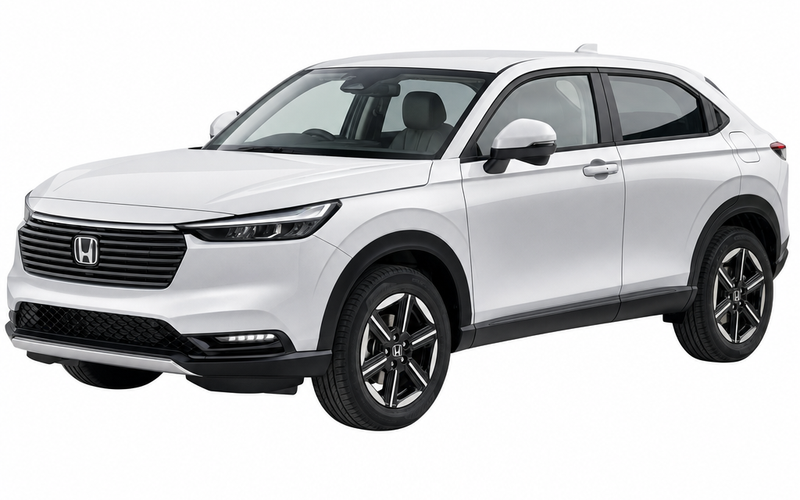
Honda HR-V: The Civic-Based Pragmatist in the Subcompact Crossover Class
The Honda HR-V sits below the CR-V in Honda's SUV lineup and shares its architecture with the Civic, which explains its composed ride and roomy cabin. In the United States market, it competes directly with the Toyota Corolla Cross, Mazda CX-30, and Kia Seltos. Rather than chasing turbo torque or aggressive styling, the HR-V leans on cargo flexibility, low ownership costs, and a smooth CVT. It is the practical choice for shoppers who want a compact footprint without sacrificing passenger or luggage space, and who plan to keep the car beyond the warranty period.
Why consider the Honda HR-V
Space efficiency is the HR-V's strongest card. The Magic Seat rear bench folds flat for long cargo or flips up to carry tall plants and small furniture, a flexibility the Mazda CX-30 cannot match. The cabin offers rear legroom closer to a compact SUV than the subcompact norm, and the Civic-derived platform delivers stable highway manners with a quiet, absorbent ride. The 158-horsepower engine is not quick, but the CVT keeps it relaxed and lets the car cruise without drama.
- Magic Seat rear configuration offers best-in-segment cargo versatility for a subcompact
- Civic-based platform provides a composed ride and predictable handling at highway speeds
- Honda Sensing safety suite — adaptive cruise, lane-keeping assist, and collision mitigation — is standard on every trim
- Consistently strong resale values and low predicted maintenance costs over five years of ownership
- Available all-wheel drive with a rear-axle disconnect for snowbelt buyers at a modest price premium
Specifications and powertrains
Gasoline (2.0L four-cylinder) — The sole US-market engine is a 2.0-liter naturally aspirated i-VTEC four-cylinder producing 158 horsepower and 138 lb-ft of torque, paired exclusively with a continuously variable transmission. EPA estimates are 26 mpg city and 32 mpg highway on front-wheel-drive models, dropping slightly to 25/30 mpg with all-wheel drive, per fueleconomy.gov.
Available drivetrains — Front-wheel drive is standard, and an on-demand all-wheel-drive system is optional on all trims. Honda does not offer a hybrid or turbocharged powertrain for the HR-V in the United States, a notable gap versus the Toyota Corolla Cross Hybrid and the turbocharged Mazda CX-30. Detailed trim-by-trim specifications are published at https://automobiles.honda.com/hr-v/specs-features-trim-comparison.
Payment reality for the Honda HR-V
The HR-V's starting MSRP is approximately $25,100 for the 2025 model year, with the EX-L trim approaching $29,500 before a roughly $1,100 destination charge. Actual monthly payments depend on your down payment, loan term, and — for leases — the residual value. Honda models historically depreciate more slowly than segment rivals such as the Nissan Kicks, which lowers lease payments and keeps financing predictable for used buyers. Enter your own figures into the CarPayCheck calculator to see a realistic monthly estimate for your zip code.
Warranty and maintenance
Honda backs the HR-V with a 3-year/36,000-mile basic warranty and a 5-year/60,000-mile powertrain warranty, with no complimentary scheduled maintenance included — a contrast to the Kia Seltos, which offers a 10-year/100,000-mile powertrain warranty. Routine oil changes are triggered by Honda's Maintenance Minder system, typically around 7,500 miles, and CVT fluid service is generally recommended in the 30,000- to 60,000-mile range. Parts availability is strong across the United States, and independent shops service the HR-V easily given the car's shared Civic components and nationwide dealer network.
Who the Honda HR-V suits
The HR-V fits first-time buyers, urban commuters, and small families who want a compact car's fuel economy with an SUV-style cargo opening. It suits drivers who prefer a smooth, quiet journey over sporty acceleration and rate low total ownership costs above all. If you need more power, the Mazda CX-30 with its optional turbocharged engine is a stronger pick, and the Kia Seltos adds a long warranty. For the lowest entry price, the Chevrolet Trax offers comparable space at a lower starting MSRP, though the Honda retains a clear ride-quality advantage.