
Ferrari
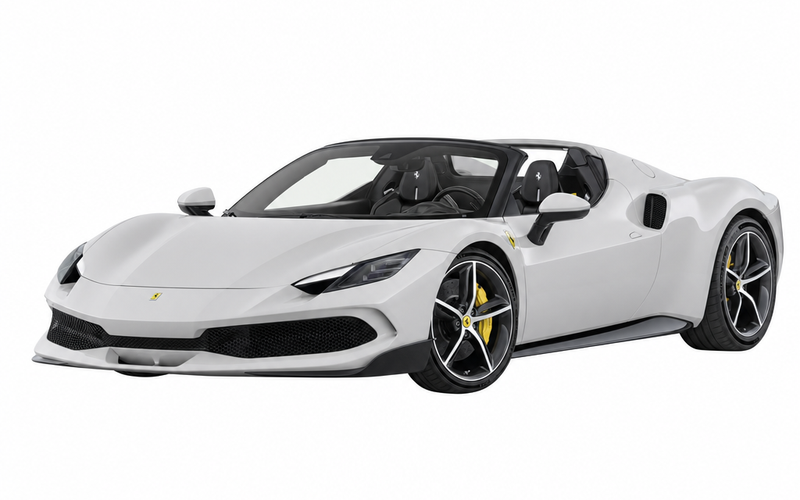
296 GTS


This estimate illustrates a vehicle lease. It is informational, not a financing offer or approval. Actual payments depend on negotiated price, residual value, money factor, mileage allowance, taxes, fees, credit, and lender terms.
This estimate illustrates vehicle financing. It is informational, not a credit offer or approval. Actual payments depend on purchase price, down payment, annual percentage rate, term, taxes, fees, credit, and lender terms.
This estimate illustrates a vehicle lease. It is informational, not a financing offer or approval. Actual payments depend on negotiated price, residual value, money factor, mileage allowance, taxes, fees, credit, and lender terms.
Ferrari 296 GTS maintenance offers offers
Ferrari 296 GTS maintenance offers offers
More
About this car
Ferrari 296 GTS: The Plug-In V6 Spider That Reshapes the Mid-Engine Convertible
The 296 GTS is Ferrari's first open-top production car built around a V6 plug-in hybrid powertrain, and it sits squarely against the McLaren Artura Spider and Lamborghini Huracán family in the mid-engine convertible class. Where many rivals lean on larger-displacement engines, the 296 GTS pairs a 3.0-liter twin-turbo V6 with an electric motor for a combined 819 hp. Its retractable hardtop operates in 14 seconds while moving at up to 28 mph, keeping coupe-level rigidity and downforce intact. Buyers cross-shop it mainly for hybrid efficiency with genuine supercar pace in a drop-top body.
Why Consider the Ferrari 296 GTS
The 296 GTS stands out in a segment that traditionally prioritizes displacement over electrification. Its 120-degree V6 with a hot-V turbo layout revs to 8,000 rpm and produces 819 hp together with the front-axle-mounted electric motor. Chase away the McLaren Artura Spider, its closest technical rival, and the 296 GTS counters with a larger output and a more communicative brake-by-wire setup. The 45-degree exotic architecture also frees cabin space and lowers the center of gravity.
- Rear-wheel-drive hybrid layout with selectable eDrive mode for up to 84 mph of silent urban running
- Active rear spoiler that deploys to add about 220 lb (100 kg) of downforce without extra drag at speed
- Retractable hardtop that preserves official performance figures identical to the GTB coupe
- Assetto Fiorano option with weight reduction and track-focused aero parts
- Fully digital cockpit adapted from the SF90 Stradale with passenger-side display
Specifications and Powertrains
Plug-in hybrid V6 — the 3.0-liter twin-turbo produces 663 hp at 8,000 rpm, with a 7.45 kWh battery and electric motor adding up to 830 cv (819 hp) total. Power flows through an 8-speed dual-clutch gearbox to the rear wheels. 0-60 mph arrives in about 2.9 seconds; top speed exceeds 205 mph. Ferrari quotes 0-100 km/h in 2.9 seconds and 0-200 km/h in 7.3 seconds, with the hardtop operation unchanged.
Efficiency figures — WLTP combined fuel consumption is around 6.7 l/100 km (about 35 mpg US on the EU cycle with electric assistance), with roughly 15 miles of zero-emission range. CO2 emissions come in near 153 g/km under the same WLTP benchmark. US EPA ratings were not published for the 2025 model year; the car carries a plug-in charge port for home or public AC charging, and eDrive mode covers urban commutes on battery alone.
Payment Reality
The 2025 296 GTS starts around $376,000, with some model-year examples listed at $379,950 before options (https://www.cars.com/research/ferrari-296_gts-2025/specs/). Typical additions like the Assetto Fiorano package or tailored interior trim push the transaction price well past $420,000. Because exotic hybrids depreciate unevenly — early demand pulls some cars above MSRP, while lease residuals are set conservatively — your monthly payment depends heavily on negotiated discount, term length, and the cap-cost reduction you bring. The federal $7,500 plug-in credit no longer applies to Ferraris above the price cap, so cash buyers and lessees should weigh depreciation and residual-value guarantees instead of incentives when comparing against the Artura Spider or a Huracán.
Warranty and Maintenance
Ferrari covers the 296 GTS in the United States with a 3-year, unlimited-mileage limited warranty and a 3-year complimentary scheduled-maintenance program, which includes oil changes, filters, and wear-item inspections at the recommended service interval of roughly every 12 months or 12,500 miles. The high-voltage battery is covered for 8 years, giving owners parity with mainstream plug-in vehicles. Hydraulic oil for the retractable top, turbocharger health, and the hybrid cooling loop should be inspected by a Ferrari dealer to keep the warranty intact; independent specialists with diagnostic equipment for the 296 platform are still scarce outside major metro areas, so factor dealer labor rates into annual running costs.
Who Ferrari 296 GTS Suits
The 296 GTS fits buyers who want an open-top daily supercar with genuine electric commuting capability, plus weekend track performance without the noise penalty of a V8 or V10. It suits owners who value a closed cockpit when desired and a silent interior during short urban runs. Honest alternatives include the McLaren Artura Spider for a lighter, more driver-feedback-focused hybrid, the Lamborghini Huracán for a naturally aspirated V10 with a different character, and the Mercedes-AMG SL 63 for a grand-touring 2+2 layout at a lower price point. Buyers who prioritize rear-seat practicality or massive daily cabin space should look elsewhere — the 296 GTS is a strict two-seater.