
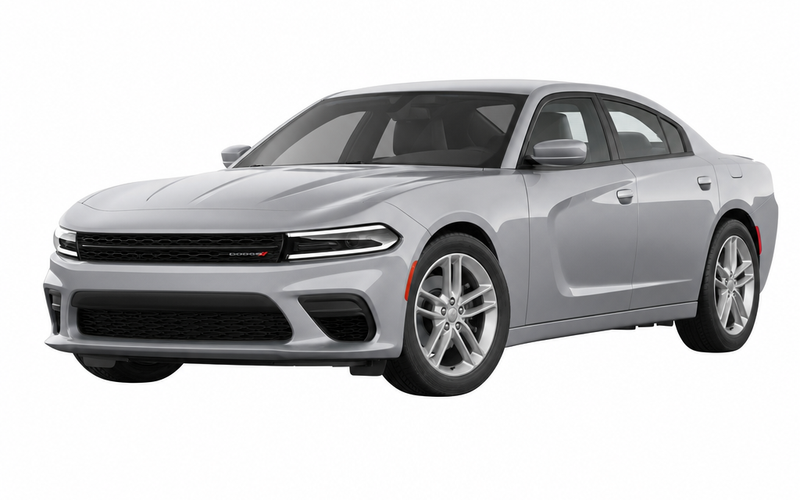
Dodge
Charger


This estimate illustrates a vehicle lease. It is informational, not a financing offer or approval. Actual payments depend on negotiated price, residual value, money factor, mileage allowance, taxes, fees, credit, and lender terms.
This estimate illustrates vehicle financing. It is informational, not a credit offer or approval. Actual payments depend on purchase price, down payment, annual percentage rate, term, taxes, fees, credit, and lender terms.
This estimate illustrates a vehicle lease. It is informational, not a financing offer or approval. Actual payments depend on negotiated price, residual value, money factor, mileage allowance, taxes, fees, credit, and lender terms.
Dodge Charger maintenance offers offers
Dodge Charger maintenance offers offers
More
About this car
Dodge Charger Positioning: A Muscle Car Lineup Reinvented as Sedan and Coupe, Gas and Electric
The 2026 Dodge Charger is no longer a single body style or a single powertrain story. Dodge has rebuilt its flagship around two-door and four-door body styles, each available with either a twin-turbo straight-six gasoline engine or a fully electric drivetrain. That places the Charger in an unusual position: it competes with traditional V8 muscle like the Ford Mustang on one side and with mainstream performance sedans such as the Toyota Camry TRD on the other, while the electric Daytona version pulls in buyers cross-shopping the Tesla Model 3. The broad lineup means the Charger is a segment of one, and that flexibility is the main reason to give it serious attention.
Why Consider the Dodge Charger
The Charger's core argument is straightforward: it offers genuine muscle-car performance with more body-style and powertrain choice than any direct rival. The 2026 model was named North American Car of the Year, a nod to how completely Dodge reworked the formula rather than resting on the previous generation's reputation. Where the Ford Mustang remains a dedicated coupe, the Charger still offers four-door practicality when you need it and a sleeker two-door when you do not.
- Standard all-wheel drive on every gasoline R/T and Scat Pack, with a one-button switch to 100 percent rear-wheel drive for burnouts
- Twin-turbo 3.0-liter SIXPACK six-cylinder replaces the old V8, delivering up to 550 horsepower in the gas Scat Pack
- The electric Daytona Scat Pack delivers 670 horsepower and a 3.3-second 0-60 mph run, per Dodge
- Two-door and four-door variants across the entire lineup, a rarity in the modern muscle segment
- Scat Pack starts at $54,995, which Dodge says is the most horsepower available under $55,000
Specifications and Powertrains
Gasoline: R/T and Scat Pack. Both use Dodge's new 3.0-liter twin-turbocharged SIXPACK straight-six. The R/T produces 420 horsepower and 468 lb-ft of torque, while the Scat Pack is tuned for 550 horsepower and 531 lb-ft, with 30 psi of peak boost. Dodge quotes 3.9 seconds to 60 mph for the Scat Pack and a 12.2-second quarter-mile. EPA fuel-economy figures for the six-cylinder were not included in Dodge's media materials, so treat range claims with caution until independent testing is published.
Electric: Daytona R/T and Daytona Scat Pack. The EV versions use a 400-volt system with a 100.5-kWh battery and dual electric drive motors. The Daytona R/T is rated at a combined 531 horsepower, while the Daytona Scat Pack reaches 670 horsepower and 627 lb-ft of torque with a 3.3-second 0-60 mph time. Dodge's signature Fratzonic chambered exhaust generates an artificial engine note to preserve the muscle-car character. Range and MPGe ratings were not quoted in the sourced materials and should be confirmed via EPA data.
Payment Reality
Monthly payments on a 2026 Charger vary enormously depending on which of the four powertrain and body combinations you choose. The R/T AWD carries a lower starting U.S. MSRP, while the Scat Pack opens at $54,995 and the Daytona electric models will command a further premium. Gasoline muscle cars historically hold value well when demand for V8-adjacent performance stays strong, but the new six-cylinder and EV versions have no resale history yet. Leasing is riskier on the Daytona EVs because no one knows how quickly battery depreciation will hit early adopters. Use the payment calculator here to model your own down payment and term rather than relying on advertised teaser rates.
Warranty and Maintenance
Dodge backs the 2026 Charger with the typical US-market coverage: a 3-year/36,000-mile basic warranty and a 5-year/60,000-mile powertrain warranty. The gasoline SIXPACK engine uses an oil-change interval aligned with severe-duty recommendations for turbocharged engines, so check the owner's manual rather than assuming the old V8's schedule carries over. The electric Daytona models eliminate oil changes but add battery and cooling-system checks at scheduled service visits. Parts availability is strong nationwide since the Charger shares the STLA architecture with other Stellantis products, and independent shops should be able to service the gasoline versions without dealer exclusivity.
Who the Dodge Charger Suits
The Charger fits buyers who want muscle-car acceleration but refuse to give up rear-seat space or all-weather traction. The four-door AWD R/T and Scat Pack are daily-driver muscle for people in snowy states, while the two-door Daytona Scat Pack appeals to EV enthusiasts who still want a dramatic, loud character rather than a silent appliance. If you need a coupe with a manual transmission or a track-focused chassis, the Ford Mustang Dark Horse remains a better fit, and buyers wanting maximum electric efficiency over straight-line drama should compare the Hyundai Ioniq 6. Against a four-door sport-sedan like the Toyota Camry TRD, the Charger trades fuel economy for substantially more power. Choose it when performance character, not practicality efficiency, is your priority. Source pricing references: https://media.stellantisnorthamerica.com/newsrelease.do?id=26970&mid=784 and https://www.dodge.com/charger.html